Shardiya Navratri 2026 Day 7: Navratri is considered to be a very sacred festival dedicated to worshipping the Navdurga. Shardiya Navratri’s nine days are believed to bring strength, prosperity, and positive energy. Different forms of the Goddess Durga are worshipped on each of the nine days, and each day has special rules, offerings, Katha, aarti, and remedies. The seventh day of Navratri is dedicated to worshipping the seventh form of Maa Durga, which is Maa Kaalratri. Come, let’s find out when the seventh day of Shardiya Navratri will be observed, which auspicious Yog’s will form on this day, and what the puja vidhi, Katha, and remedies of the Goddess are.
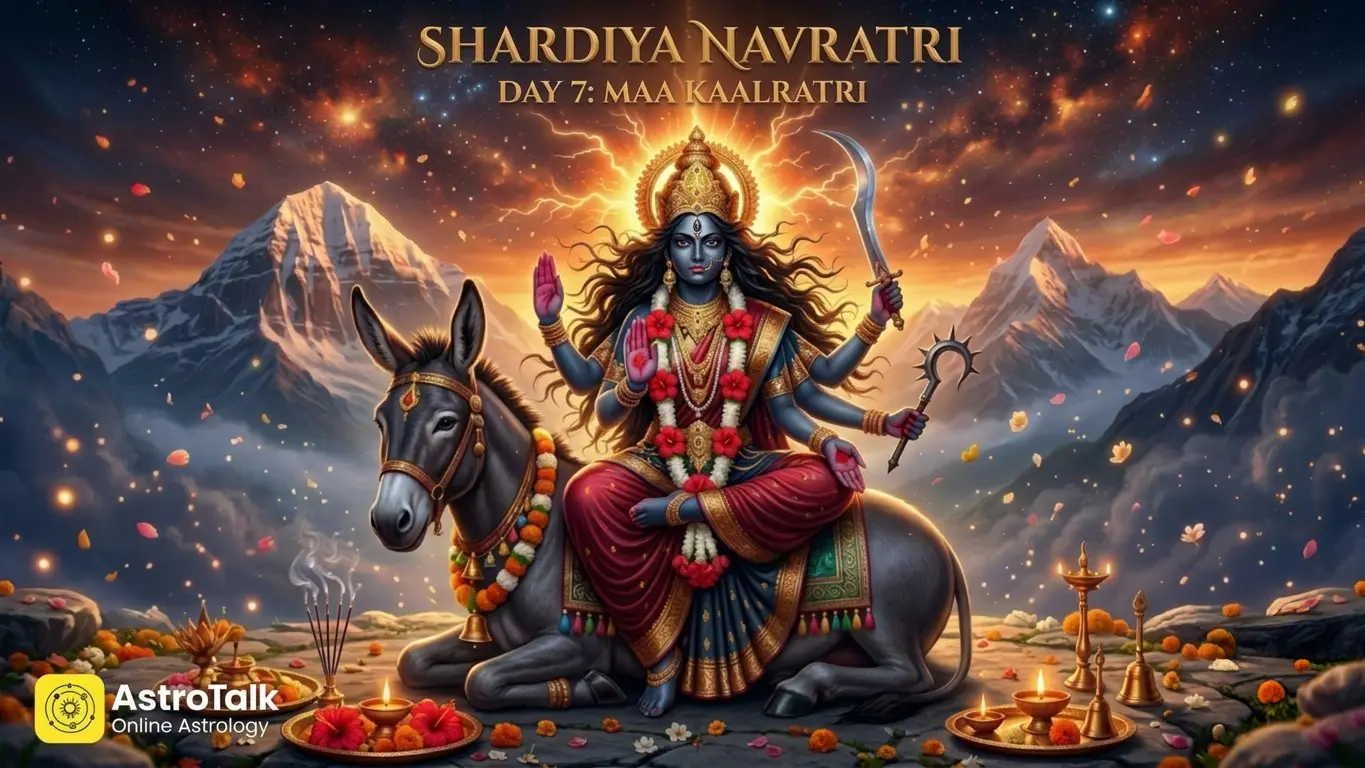
According to the Panchang, the seventh day of Shardiya Navratri falls on the Saptami Tithi of the Shukla Paksha in the Ashwin month. This year, the seventh day of Shardiya Navratri will be on Saturday, October 17, 2026, and Maa Kaalratri will be worshipped on this day. This form of Maa Durga is very fierce. Worshipping Maa Kaalratri provides relief from all troubles.
After Maa Katyayani, the seventh day of Navratri is dedicated to worshipping Maa Kaalratri. It is believed that worshipping Maa Kaalratri removes all kinds of negative energies. On the seventh day of Navratri, wake up early, take a bath, and wear grey or blue clothes for Kaalratri Puja. After this, place the idol or picture of Maa Kaalratri. Now offer Roli, Akshat, Sandalwood paste, flowers, fruits, naivedya, etc., to the Goddess and light a Diya. Maa Kaalratri especially likes jaggery and jaggery-based items as an offering. In the end, perform Maa Kaalratri’s aarti and seek forgiveness for any mistakes. After this, distribute the prasad among everyone.
For information about Shardiya Navratri Puja, remedies, or other details, you can chat with an astrologer for free.
According to mythology, there was a very powerful and magical demon named Raktbeej who had created terror across the universe. But killing him was almost impossible. He had received a boon that if even a single drop of his blood fell on the ground, a new Raktbeej demon would be born from that drop of blood. The gods were tense because of Raktbeej’s power.
When the gods had no solution left, they called Maa Durga for help. To protect creation, Maa Durga became extremely fierce and terrifying in anger, and this form of Maa Durga came to be known as Kaalratri. In this form, the Goddess had a dark complexion, dishevelled hair, and garlands around her neck that looked like lightning. During the battle, Maa Kaalratri attacked Raktbeej and collected the drops of blood coming out of his body with her large tongue. In this way, before the blood from Raktbeej’s body could fall on the ground, the Goddess absorbed it with her tongue and killed him. Although the Goddess has a fierce and terrifying form, she always blesses her devotees with auspicious results; that’s why she is also known as Shubhamkari.
Kalaratri jay-jay-mahakali. Kal ke muh se bachane vali.
Dusht sangharak nam tumhara. Mahachandi tera avatar.
Prithvi aur akash pe sara. Mahakali hai tera pasara.
Khadag khappar rakhane vali. Dushton ka lahoo chakhane vali.
Kalkatta sthan tumhara. Sab jagah dekhoon tera najara.
Sabhi devata sab nar-nari. Gaven stuti sabhi tumhari.
Raktadanta aur annapoorna. Kripa kare to koi bhi duhkh na.
Na koi chinta rahe bimari. Na koi gam na sankat bhari.
Us par kabhi kasht na aave. Mahakali man jise bachabe.
Tu bhi bhakt prem se kah. Kalaratri maa teri jay.




Choose your and your partner's zodiac sign to check compatibility



Copyright 2022 CodeYeti Software Solutions Pvt. Ltd. All Rights Reserved