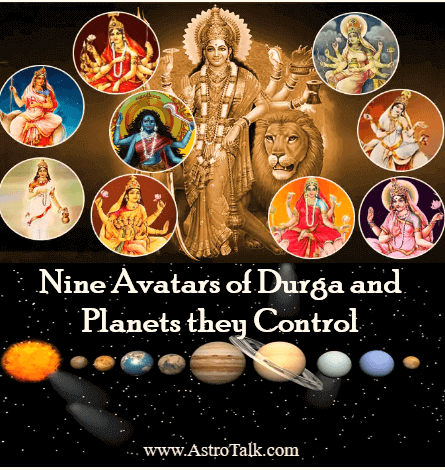
Navratri marks the celebration of the divine feminine power, also known as Shakti. Devotees worship the 9 avatars of Durga across nine sacred days and nights, known as the Navadurga.
Each form of Maa Durga is associated with a different quality of the divine energy. Some forms represent courage, some symbolise wisdom and discipline, while others represent motherhood, protection, purity, and spiritual awakening.
However, these 9 avatars of Goddess Durga are not only important from a religious perspective but also hold a strong connection to the 9 celestial influences of the Navagraha.
From the powerful Sun to the shadows of Rahu and Ketu, each planet represents different qualities in human life. Therefore, worshipping Maa Durga during Navratri is often seen as a way of connecting with these energies through spiritual practices.
Here you will find a complete guide to the 9 avatars of Maa Durga during Navratri, their significance, and the planets associated with them according to traditional astrology.
| Navratri Day | Avatar of Maa Durga | Associated Planet | Represents |
| Day 1 | Maa Shailaputri | Sun | Strength & Stability |
| Day 2 | Maa Brahmacharini | Saturn | Discipline & Devotion |
| Day 3 | Maa Chandraghanta | Moon | Peace & Courage |
| Day 4 | Maa Kushmanda | Jupiter | Growth & Wisdom |
| Day 5 | Maa Skandmata | Mars | Motherhood & Strength |
| Day 6 | Maa Katyayni | Venus | Love, Beauty, & Determination |
| Day 7 | Maa Kalaratri | Rahu | Fearless & Protection |
| Day 8 | Maa Mahagauri | Mercury | Purity & Clarity |
| Day 9 | Maa Siddhidatri | Ketu | Spiritual Wisdom & Liberation |
The 9 avatars of Durga during Navratri are collectively known as Navadurga. Each day of Navratri is dedicated to a form of the Goddess.
These nine forms are:
Together, these 9 forms represent different stages and expressions of the divine energy. The journey starts with Shailaputri, the daughter of the mountains, and ends with Siddhidatri, who bestows spiritual accomplishments. The nine manifestations of the goddess can also be seen as a journey of inner transformation, from stability and discipline to courage and spirituality.
The first on the list of 9 Avatars of Goddess Durga is Maa Shailaputri.
The name Shailputri means ‘the daughter of the mountain’. In Hinduism, she is considered a form of Goddess Parvati and is also known as the daughter of Himavan.
Maa Shailputri is depicted riding a bull, Nandi. She carries a trident in one hand and a lotus in the other.
She represents:
Planets Associated with Maa Shailputri: Sun
In astrology, Maa Shailaputri is connected to the Sun. The Sun symbolises self-confidence, authority, vitality, and expression. Thus, worshipping Mata Shailaputri is an age-old tradition associated with gaining self-confidence and taking on responsibilities.
She makes us understand that any new journey requires a solid foundation.
The second form among the Durga Maa 9 Avatars is Maa Brahmacharini.
She symbolises devotion, discipline, and spiritual determination. Her name means life spent in penance and austerity.
The depiction of Maa Brahmacharini shows her walking barefoot, with a rosary in one hand and a kamandalu in the other.
Her cosmic energy symbolises:
Planet Associated with Maa Brahmacharini: Saturn
Maa Brahmacharini is usually represented by the planet Saturn in this planetary framework.
Planet Saturn symbolises discipline, responsibility, patience, and the teachings that help us mature. Just as Saturn makes us understand that achieving something significant requires both time and effort, Maa Brahmacharini is known for her dedication and commitment.
The third among the 9 avatars of Maa Durga in Navratri is Maa Chandraghanta.
She derives her name from the crescent moon on her forehead in the shape of a bell. Maa Chandraghanta is known for her warrior-like posture and her readiness to protect devotees from evil elements.
She is often portrayed as riding a tiger or lion and holding many weapons.
Maa Chandraghanta symbolises:
Planets Associated with Maa Chandraghanta: Moon
In this interpretation, Maa Chandraghanta is related to the Moon.
The moon represents the mind, emotions, imagination, and sensitivity. Maa Chandraghanta’s nature is powerful yet compassionate, reflecting the need to maintain emotional balance while also standing up against fear.
Her energy teaches us that being peaceful does not mean being powerless.
Maa Durga’s fourth form is known as Maa Kushmanda.
She is frequently referred to as the Goddess who created the universe through her divine smile. The name Maa Kushmanda is also associated with the concept of the cosmic egg, which symbolises the creation and birth of life.
Maa Kushmanda is depicted with numerous arms, each holding a divine object.
She symbolizes:
Planet Associated with Maa Kushmanda: Jupiter
Maa Kushmanda is usually associated with the planet Jupiter.
It is because Jupiter is the planet of wisdom, expansion, optimism, prosperity and higher knowledge. This connection reflects Maa Kushmanda’s role as a source of creation and life-giving energy.
Wroshipping her represents a desire for growth, clarity, and a positive outlook towards life.
Maa Skandamata is the fifth amongst the 9 avatars of Durga.
She is referred to as the mother of Lord Skanda, also known as Lord Kartikeya. Maa Skandamata is often seen carrying Lord Skanda on her lap, sitting on either a lotus or a lion.
This avatar depicts the mothering aspect of divine energy.
Maa Skandamata represents:
Planet Associated With Maa Skandamata: Mars
This particular avatar is represented by Mars in the planetary system.
Mars signifies energy, courage, action and determination. Even though Maa Skandamata is a motherly avatar, she embodies the strength needed to protect the people dear to us.
Her strength reminds us that true strength can be both gentle and fearless.
The sixth manifestation of Maa Durga is Maa Katyayani.
She is considered to be the most powerful warrior manifestation of the Goddess. She emerged to combat the evil forces and restore dharma.
The depiction of Maa Katyayani is always on a lion, armed with weapons, symbolising her strength and determination to uphold dharma.
She symbolizes:
Planets Associated with Maa Katyayani: Venus
Maa Katyayani is related to the planet Venus.
Venus signifies love, beauty, relationships, creativity and pleasure. But the connection also makes us realise that true beauty is also an expression of strength and self-respect.
Maa Katyayani teaches us to embrace love, but with strength within.
Maa Kalaratri is the seventh avatar among the Navratri forms of Maa Durga.
Maa Kalaratri is always depicted with an aggressive and fearsome appearance. Her usual features include a dark complexion, flowing hair, and fearless demeanour. She is depicted riding a donkey and is known as a destroyer of ignorance and fear.
However, despite her fearsome appearance, Maa Kalaratri is known to be extremely protective of her followers.
She embodies:
Planet Associated With Maa Kalaratri: Rahu
Maa Kalaratri is associated with Rahu in this planetary association.
Rahu is often related to mystery, ambition, illusions, and out-of-the-box experiences. It refers to the mysterious areas of life that require one to step outside one’s comfort zone.
The eighth among the 9 Avatars of Durga in Navratri is Maa Mahagauri.
The name Mahagauri means ‘very radiant’ or ‘greatly fair.’ She is symbolic of purity, tranquillity, and spiritual cleansing.
Goddess Maa Mahagauri is usually depicted wearing white attire and is associated with a tranquil, kind aspect of divine energy.
Goddess Maa Mahagauri is symbolic of:
Planet Associated with Maa Mahagauri: Mercury
In this context, Goddess Maa Mahagauri is associated with the planet Mercury.
Mercury stands for communication, knowledge, intellect, learning, and adaptability. The tranquil, clear energy of Maa Mahagauri can be associated with thinking and communicating wisely and clearly.
Worshipping her makes us realise that the tranquil mind often perceives things which the agitated mind does not.
The ninth and last form among the Durga Maa 9 avatars is Maa Siddhidatri.
In the name of Maa Siddhidatri, “Siddhi” means accomplishment, while “Datri” means the giver. It represents the culmination of the Navratri worship and supreme spiritual accomplishment.
Usually, Maa Siddhidatri is depicted seated on a lotus, holding divine weapons such as a chakra, conch, and mace.
Planet Associated with Maa Siddhidatri: Ketu
Traditionally, Maa Siddhidatri is considered to be associated with Ketu.
Ketu is associated with spirituality, detachment, intuition, and the quest for higher meaning in life. While physical desires are common for Ketu, it makes a person look within themselves.
Thus, the link between Maa Siddhidatri and Ketu is absolutely harmonious.
The 9 avatars of Maa Durga can be understood as more than nine individual forms of worship.
Together, they represent a journey.
It starts with Shailaputri, who lays the foundation, while Brahmacharini teaches discipline. Chandraghanta gives courage, and Kushmanda brings creative energy. Skandamata shows the strength of nurturing love.
Katyayani encourages us to fight for our rights. Kalaratri encourages us to confront the darkness within us. Mahagauri signifies purity. Lastly, Siddhidatri symbolises spiritual fulfilment.
This is one of the reasons the Navratri Festival is considered highly significant.
We can consider this a spiritual journey that moves from external to internal reality.
Each day is dedicated to a different form of the Goddess during Navratri.
Worshipping the 9 avatars of Goddess Durga signifies all the different facets of femininity as a divine force. Maa Durga is not defined just by a single attribute.
She can be caring like Skandamata, strict like Brahmacharini, calm like Mahagauri and fearsome like Kalaratri.
And this is what makes Navadurga so beautiful.
The goddess embodies compassion as well as fearlessness. She is a protector and creator of life. She is both a mother and a warrior.
In astrology, Navagraha is related to various types of energy and fields.
Some examples include:
The planet related to the 9 avatars of Durga combines spirituality and astrology.
The 9 avatars of Durga include Shailaputri, Brahmacharini, Chandraghanta, Kushmanda, Skandamata, Katyayni, Kalaratri, Mahagauri, and Siddhidatri. Together, they are called Navadurga.
Maa Shailaputri is worshipped on the first day of Navratri. She is considered the first of the nine avatars of Maa Durga.
All nine avatars of Maa Durga possess their own importance and power. While Kalaratri is known for her aggressive appearance and protection, Katyayani is the warrior power, and Siddhidatri is known for her spiritual power. Rather than one form being universally ‘more powerful’, each form represents a different expression of Shakti.
Navadurga represents the nine forms of Goddess Durga worshipped during Navratri. Each form is associated with a specific day and symbolises a unique quality of the divine feminine energy.
Indeed, many astrological systems link the nine forms of Maa Durga to the nine planets. But the connection may vary depending on the particular astrological framework and traditions followed.



Choose your and your partner's zodiac sign to check compatibility


Copyright 2022 CodeYeti Software Solutions Pvt. Ltd. All Rights Reserved